

- What drives inquiries is less the design than the structure: visitors must immediately understand what the agent offers, why they can trust them and what the next step is.
- A hero with a concrete benefit and a direct entry point, such as a property valuation, actively engages property owners.
- An explained process, proven results, current listings and a personal presence lower the barrier to getting in touch.
- The same structure works as a landing page for Google Ads campaigns on property valuation and property sales.
 7:33
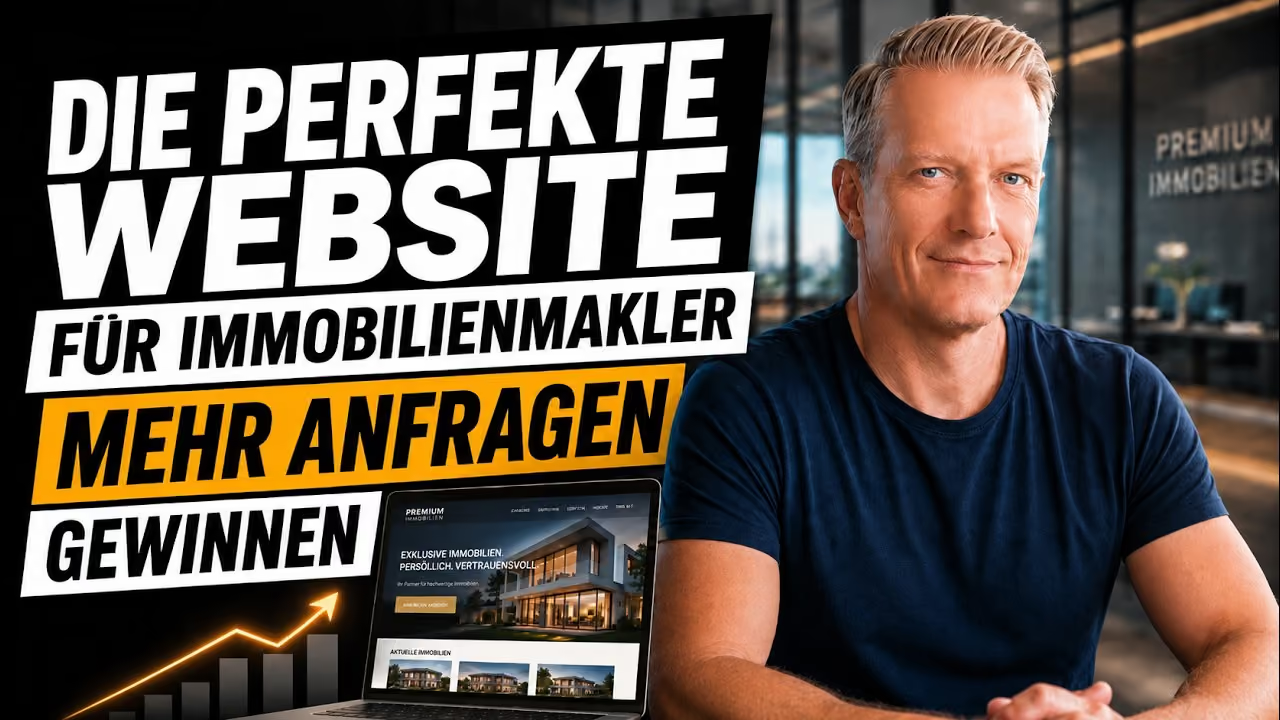
Today, a good website for real estate agents has to do more than look professional. It should build trust, win over property owners and bring in qualified inquiries. In the competition for sales mandates, what matters most is the structure of the page, the user guidance and how clearly the visitor is led to the next step.
Many real estate agent websites look high-end but lose potential clients because important information is missing, the next step is unclear or too little trust is built. A successful website therefore works like a well-planned landing page: clear, convincing and focused on inquiries. In this article, we show how it should be structured and which elements must not be missing.
The structure of your website determines inquiries
A modern, reputable design is important, but on its own it does not bring inquiries. What matters is whether a visitor immediately understands:
- What does this agent offer?
- Why should I entrust my property to them?
- How does the collaboration work?
- What is the next step?
That is why the website needs a clear structure that guides the visitor step by step: from the first impression through building trust to getting in touch or requesting a property valuation.
1. Clear navigation orients property owners from the first moment
The navigation is one of the first elements visitors notice. It should contain only the items that are truly relevant to potential clients, for example:
- Process
- Benefits
- Listings
- Reviews
- About us
- Contact
A clearly visible call-to-action button is especially important, for example “Start valuation,” “Value your property” or “Get in touch.” The visitor should always know what they can do next.
2. Your hero section decides whether a visitor stays
The hero is the first visible section of your website. This is often where it is decided within a few seconds whether a visitor stays or leaves the page. A strong hero for real estate agents does three things: it appeals emotionally, names concrete benefits and invites direct interaction.
A good headline could be: “Sell your property safely, quickly and at the best possible price.” Below it are three clear benefits, for example:
- Well-founded valuation of your property
- Personal marketing strategy
- Support from the initial consultation to the notary appointment
A direct interactive element is particularly effective, such as a property valuation tool or a short entry into the inquiry. This actively engages the visitor and gets them to take the first step toward an inquiry.
3. An explained process builds trust and lowers barriers
Many property owners sell a property only once in their lives. For them, the sale comes with uncertainty. They wonder how the collaboration works, what costs arise, whether they can trust the agent, whether they will get a good price and what happens after the first inquiry.
A good real estate agent website actively addresses these uncertainties. A simple step-by-step explanation of the process works best:
- Initial consultation or property valuation
- Analysis of the property and assessment of the market price
- Development of a marketing strategy
- Presentation of the property on suitable channels
- Viewings, negotiations and closing the sale
This way, the visitor immediately understands what to expect, and getting in touch becomes much easier.
It is also worth adding a bar with trust elements directly below the hero. It contains short, verifiable statements:
| Trust element | What you show |
|---|---|
| Experience | Years in the regional market |
| Success | Number of properties sold |
| Expertise | Regional market knowledge |
| Service | Personal support |
| Feedback | Reviews from property owners |
These signals make your competence visible at a glance. Use only figures you can prove.
4. Proven results show why property owners should work with you
Once initial trust is established, the visitor needs clear reasons to hire you specifically. General qualities such as “competent,” “reliable” or “experienced” are not enough. Concrete results and traceable evidence are more convincing:
- average time to sell
- sale prices achieved relative to the asking price
- Number of properties sold
- regional specialization
- successfully marketed comparable properties
- Customer reviews and testimonials
Real customer testimonials are especially valuable. Short reviews build trust, detailed testimonials provide context. Ideally, they show what the owner needed, how the collaboration went and what result was achieved.
5. Current listings prove that property owners trust you
Current listings show that you are active in the market and that other owners have already entrusted their properties to you. Anyone who sees that an agent markets attractive properties perceives them as more successful and relevant.
Current listings increase your credibility, invite clicks and show the quality of your marketing. High-quality property photos, short descriptions and clear information appeal to buyers while also showing owners: my property would be well presented here.
6. Your personality tips the balance, because people hire people
Selling a property is a matter of trust. Owners want to know who they are entrusting their property to. Your website should therefore not feel anonymous. A personal section about you and your team includes:
- professional photos
- short professional background
- experience in the real estate market
- regional expertise
- a personal statement
- values and way of working
A good statement explains why you work as an agent, what matters to you in the collaboration and how you guide owners through the sale. Especially with a decision of this magnitude, personality often tips the balance.
7. Your FAQs answer questions before they become obstacles
Many visitors still have open questions before getting in touch. If they remain unanswered, they leave the page. An FAQ section addresses typical uncertainties directly:
- What does working with a real estate agent cost?
- How does a property valuation work?
- How long does it take to sell a property?
- Which documents are needed?
- Do I have to decide on a sale right away?
- How is the asking price determined?
- Which marketing measures do you use?
- What happens after the first inquiry?
Good FAQs create transparency and show that you know the questions and concerns of property owners. They have a second effect: owners also ask such questions to ChatGPT or Google's AI search. Clear, concrete answers on your website increase the chance that your office is cited as a source there.
8. A clear final call leads visitors to the inquiry
At the end of the page, after all the information, benefits and reviews, the visitor needs a clear next step. This final call should be placed prominently and worded concretely, for example:
- “Start your property valuation now”
- “Request a consultation”
- “Selling your property? Get in touch now”
“Learn more” is usually too weak. Better is wording that names the benefit directly. The visitor should know exactly what happens when they click.
9. This structure turns your Google Ads clicks into inquiries
The structure described is particularly suitable as a landing page for Google Ads campaigns on property valuation and property sales. Visitors from Google Ads search specifically for terms such as “value property,” “sell house,” “real estate agent near me” or “sell apartment.” After the click, they expect relevant information quickly and a simple next step.
A good landing page for real estate agents therefore immediately picks up the search intent, builds trust, names concrete benefits, explains the process, removes barriers and enables a simple inquiry. The better the page matches expectations, the more clicks turn into inquiries.
What determines profitability is what becomes of the inquiries. Measure inquiries as conversions and check which of them lead to sales mandates. Only then do you see which campaigns bring you commission and profit. More on this in our articles on Google Ads for real estate agents and real estate companies and on conversion tracking.
Conclusion: The perfect real estate agent website leads visitors straight to the inquiry
The perfect website for real estate agents needs a clear strategy. It meets visitors where they are, builds trust, answers questions and makes the path to getting in touch as simple as possible. The most important elements are clear navigation, a strong hero, a visible call to inquire, trust elements, an understandable process, proven results, customer reviews, current listings, a personal presence, FAQs and a final call.
For agents who want to win new property owners through Google Ads or SEO, this structure is a decisive success factor. In the end, what counts is how many visitors take the next step and how many of them become mandates. You can find more about our work in the industry on our page for real estate companies.