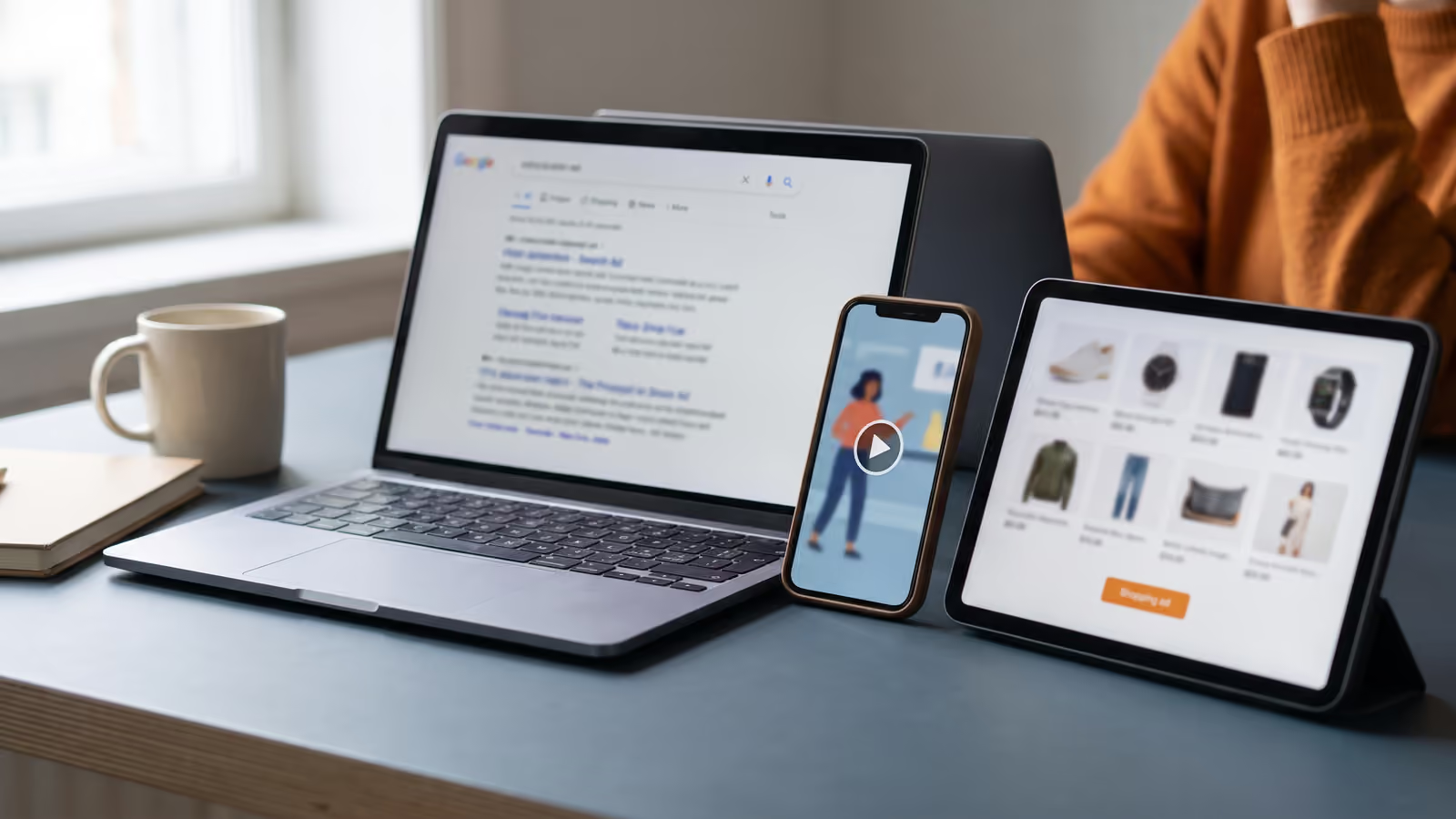

- Search campaigns reach people with a specific need. Responsive search ads automatically combine up to 15 headlines and 4 descriptions.
- Performance Max covers all of Google's inventory; Demand Gen builds demand on YouTube, Discover and Gmail before anyone searches.
- Dynamic Search Ads are being folded into AI Max for Search campaigns. In AI search, ads only appear with AI-powered targeting.
- Signals determine success: conversion values that reflect profit, enhanced conversions and data-driven attribution.
Success with Google Ads today comes from combining artificial intelligence, good data and strong creative. Google's AI increasingly handles bidding, ad copy and delivery.
The work has shifted from hands-on account tinkering to strategic direction: the quality of the signals you give Google determines your results. In this overview, we cover every major Google ad format, what each is best for and what matters in bidding and measurement.
Search campaigns reach customers the moment they need you
Search campaigns are the foundation of search engine marketing. They reach people exactly when they're looking for a solution. Other formats first have to capture attention; search answers a need that already exists.
Responsive search ads recombine your copy for every search
The standard search format is the responsive search ad. Instead of fixed ads, you provide a pool of copy:
- How it works: You add up to 15 headlines and up to 4 descriptions. Google shows up to 3 headlines at a time.
- AI-driven assembly: Google recombines these elements in real time based on the search, the device and past performance.
- Strategy: Every line must work in any combination. Vary benefits, calls to action and keywords instead of rephrasing the same message.
AI Max replaces Dynamic Search Ads
For websites with a large or frequently changing range, Dynamic Search Ads (DSA) were long the safety net: Google crawled the site and, for relevant searches, generated an ad with the right landing page itself. That captured specific long-tail searches no keyword list covers.
That job now goes to AI Max for Search campaigns. Google will migrate existing DSA campaigns automatically by February 2027. AI Max adds search term matching, tailored ad copy and landing page selection to your Search campaigns, with controls for brand, location and copy guidelines. We recommend making the switch yourself, using an experiment, so you can see which landing pages AI Max picks.
Call assets generate inquiries by phone
Call assets turn a search ad into a direct route to a phone call. Depending on the context, the AI decides whether to emphasize the call button or the website link to make the most valuable interaction more likely. For service businesses that win jobs over the phone, this is often the most important contact channel.
Performance Max uses all of Google's inventory in a single campaign
Performance Max is a goal-based campaign type that covers all of Google's inventory. Instead of running each channel separately, it allocates budget wherever a conversion is most likely.
- Inventory: Search, Shopping, YouTube including Shorts, Display, Discover, Gmail and Maps in one campaign.
- Asset groups: Because ads are assembled dynamically, format variety is key. You need landscape, portrait and square images, logos and videos.
- Audience signals: Customer lists or custom segments give the AI a starting point. If it finds better conversion opportunities outside those groups, it reaches those users too.
- Control: Performance Max now offers a full search terms report and a channel performance report. You exclude irrelevant searches with campaign-level negative keywords.
Demand Gen builds demand before anyone searches
Demand Gen bridges the gap between traditional display advertising and search. The campaigns place visual ads in users' feeds. The goal is to spark interest and build brand recall before anyone actively looks for a solution.
- Visual placements: YouTube Shorts, YouTube feed and in-stream, Discover and Gmail. At Google Marketing Live 2026, Google also announced Google Maps inventory.
- Shoppable ads: With a linked product feed, products appear directly below videos or images, making the path from inspiration to purchase much shorter.
- Audiences: Demand Gen supports lookalike segments that help you find people similar to your existing customers.
YouTube video campaigns connect awareness and sales
YouTube offers far more than simple video playback. With short and long formats, you reach people in very different situations.
| Format | Skippable | Length |
|---|---|---|
| Skippable in-stream ads | after 5 seconds | no maximum; under 3 minutes recommended |
| Non-skippable in-stream ads | no | 15 to 60 seconds, depending on campaign type |
| Bumper ads | no | 6 seconds |
| Shorts ads | immediately, by swiping | under 60 seconds recommended |
Non-skippable formats and bumpers suit awareness and frequency because the full message gets through. Shorts are vertical (9:16) and need to feel like the content around them. Authentic, UGC-style videos often outperform polished high-end productions here.
Shopping campaigns bring high-intent buyers to your store
Shopping ads show product image and price directly in the search results. For online retailers, they're the most important lever for attracting visitors with strong purchase intent.
- Standard Shopping and Performance Max: Standard Shopping gives full search term transparency; Performance Max often drives more volume through automation. At Google Marketing Live 2026, Google also introduced AI Max for Shopping campaigns.
- Priorities: Campaign priorities (high, medium, low) and negative keywords let you bid less on generic searches than on specific purchase queries.
Every Shopping campaign is built on the product feed. Titles, images, prices and availability determine which searches your products appear for. Learn more on our page about data feed management.
Local ads bring nearby customers through your door
Local ad formats are designed for businesses that serve a specific area. They shorten the path to contact by putting trust and direct contact options front and center.
- Local Services Ads: You pay per lead, by call or message, not per click. Google screens providers in advance and labels them. In Germany, the format is only available in selected industries.
- Google Maps: Ads in map search and promoted pins lead users straight to your business. You need a well-maintained Business Profile linked to Google Ads.
We set bid strategies to maximize your profit
Modern bid strategies adjust every bid in real time, based on many signals such as device, location, time of day and past behavior. The aim is to spend your budget where it best achieves your goals.
- Target CPA: Optimizes for a target cost per conversion; well suited to lead generation.
- Target ROAS: Optimizes for conversion value. If those values reflect margin rather than revenue, Google optimizes for your profit.
- Portfolio strategies: Several campaigns share one strategy. Data is pooled, and the learning phase gets shorter.
Good measurement determines how well automation performs
Algorithms can only optimize as well as the data allows. With browsers and missing consent limiting cookie-based tracking, first-party data is moving center stage.
- Enhanced conversions: Data users have provided themselves, such as their email address, is hashed (made unreadable) and sent to Google. That lets conversions be matched to the right click even without cookies.
- Data-driven attribution: The model credits every touchpoint on the path to purchase instead of rewarding only the last click. Apart from last click, it's the only model Google Ads still offers.
- Consent Mode v2: Required for measurement and remarketing for users in the European Economic Area.
Our guide to conversion tracking explains how to set up tracking end to end.
In AI search, ads appear through AI-powered targeting
More and more searches end in an AI answer, whether in AI Overviews or Google's AI Mode. In Germany, ads currently appear above or below AI Overviews. So far, Google shows ads directly within AI Overviews in English in selected countries, and is testing new formats in AI Mode in the US.
For these placements, Google requires AI-powered targeting: broad match keywords, AI Max, Performance Max or Shopping campaigns. Our article on ads in AI Mode shows how to prepare your campaigns.
Conclusion: Profit contribution decides your format mix
Google Ads now demands a clear structure and high-quality signals. Performance Max drives volume, Demand Gen builds demand, search converts it, and local ads secure your presence on the ground. Clean measurement underpins them all.
Which formats you use should not be a matter of habit. Evaluate ad formats by their contribution to your goals and the costs involved. Adjust your budget allocation accordingly.